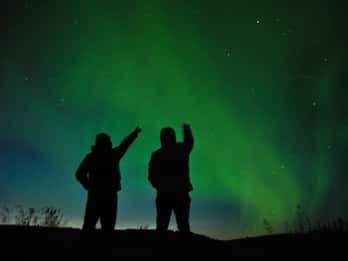
The polar night, and what your tour will actually look like
Late November to mid-January the sun stays below the horizon. That is not the same as darkness, and knowing the difference shapes your booking.
The short answer
From late November to mid-January the sun stays below the horizon in Tromsø, but daytime tours still run in a few hours of blue twilight around midday. You see the landscape clearly, only softer and bluer than in the product photos. In December and early January, book daytime tours at the slot closest to midday; evening tours run in real darkness, which is what the aurora hike needs. For sharp daylight views and dark evenings in the same week, go in February or March.
Tromsø sits about 350 kilometres north of the Arctic Circle, and from late November to mid-January the sun never clears the horizon. Most visitors imagine round-the-clock blackness; what the polar night delivers around midday is a few hours of deep blue twilight, with the sky glowing over snow, often with pink and orange at the southern horizon on clear days. Daytime tours run in that light. Evening tours run in real darkness. Both are worth booking; they are just different products, and the brochure photos with sunshine were not taken in December.
The tour built for the dark
The snowshoe tours that fit this page, side by side. Open a card for the meeting point, what to bring and the full details.
Legendary Adventure AS
Aurora Snowshoe Evening Hike
Darkness is this tour's raw material: ~3 hours on snowshoes at Ersfjordbotn, max 8 guests. A young listing, so read its top rating as a small sample.
Duration: 4 hours (about 3 hours on snowshoes)
✓ Free cancellation up to 24 hours before the tour
Evening snowshoe hike away from the city lights, around Ersfjordbotn, with a real chance of northern lights on clear nights
Run by Legendary Adventure AS in small groups of max. 8, with about 3 hours of snowshoeing within a 4-hour tour
Rated at the top of this comparison so far, but it is a young listing, so read the score as a small sample
About this tour
Snowshoeing after dark sounds odd until you try it: the snow reflects what light there is, headlamps do the rest, and away from Tromsø's street lights the night sky opens up. Legendary Adventure AS, the same operator as the small-group Arctic wilderness hike in this comparison, runs this 4-hour evening tour around Ersfjordbotn on Kvaløya, with about 3 hours on snowshoes and never more than 8 guests. On clear evenings with solar activity, that means a real chance of watching the northern lights from the trail without booking a separate aurora chase.
The tour is young. Its top rating rests on a small number of ratings so far, which is a promising sample rather than a track record. Treat the rating accordingly; the current rating and review count are shown live on the tour card.
Know before you go
No operator can promise the northern lights; sightings depend entirely on weather and solar activity. The snowshoe hike is the guaranteed part.
The rating rests on a small number of ratings so far. That is promising, but read it as a sample, not a track record.
Evening in the Arctic is colder than daytime, so bring warm layers under the provided gear.
Content taken from the operator's product page on the booking platform.
The prices for these snowshoe tours are read live from GetYourGuide, taxes and booking fees included, and match the checkout total.
What blue twilight means for a daytime tour
In the polar-night weeks, a midday snowshoe tour is neither dark nor bright. It happens in what photographers call the blue hour, stretched over several hours. In practice you see the landscape clearly, the snow amplifies every bit of sky light, distances read softer and colours shift towards blue. Reviewers do not complain about it; the ones who mention it tend to call it atmospheric. What it is not is sunshine on white peaks. If seeing far and sharp is central to your trip (photographing panoramas, spotting distant fjord arms), aim for February or March instead. If mood is what you are after, the polar night is arguably the most distinctive light Tromsø offers all year.
Month by month
Month
Light situation
What it means for snowshoe tours
October
Normal autumn days, shortening fast
Wandering Owl's season opens 1 Oct, often as a hike rather than a snowshoe walk while coastal snow is thin
November
Days shrink toward the polar night; the last sunrise comes in late November
Shoulder month: snow arrives, light leaves. Daytime slots sit close to midday
December
Full polar night, with blue twilight for a few hours around midday
Daytime tours run in twilight; evening tours in deep darkness. Aurora season in full swing on clear nights
January
Polar night ends mid-month; light returns strikingly fast afterwards
Early January is still twilight-only; by late January there are real daylight windows
February
Proper daylight hours, lengthening every day
Deep snow plus real light: daytime tours show the landscape at full range; evenings still long and dark for aurora
March
Long days, equinox at the end of the month
Often the sweet spot: solid snow, generous daylight, and still enough evening darkness for the aurora hike
April
Very long days; darkness becomes scarce
Late-season snowshoeing in spring light (Wandering Owl runs to 15 Apr), but the aurora window closes as nights turn pale
How to pick your slot
Three practical rules fall out of the table. First: in December and early January, book daytime tours at the slot closest to midday. That is where the twilight is brightest, and the operators schedule accordingly. Second: the aurora evening hike works all winter, because darkness is the one resource the season never runs short of, but its best months combine darkness with stable snow, roughly December to March. Third: if your trip is specifically about seeing the landscape in daylight and chasing the aurora at night, February and March give you both in the same week. The best-time page weighs the months in full.
Photography in the polar night
Knowing the light beats owning gear. In blue twilight, phone cameras do better than expected because the snow acts as a giant reflector, but motion blurs quickly, so shoot in the pauses, not mid-stride. The southern horizon around midday often carries the day's only warm colours; face that way for the postcard shot. At night, aurora photography is its own craft, but the short version: stabilise the camera on anything solid, use a few seconds of exposure, and keep a spare battery warm in an inner pocket, because cold drains batteries fast. On the Wandering Owl daytime hike, the guide's included photos take the pressure off entirely.
FAQ
Is it completely dark in Tromsø during the polar night?
No, that is the biggest misconception. From late November to mid-January the sun stays below the horizon, but around midday there are a few hours of soft blue twilight, bright enough to hike, see the landscape and take photos. Real darkness rules the mornings, evenings and nights.
Do daytime snowshoe tours run during the polar night?
Yes, scheduled around the midday twilight. The experience is atmospheric rather than panoramic: you see the terrain clearly, in deep blue tones, without sunshine. If bright long-range views matter most to you, February and March are the better window.
When does the light come back?
The polar night ends in mid-January, and the light returns remarkably fast. Tromsø gains daylight at a pace that surprises visitors. By February there are proper daylight hours; by late March, days are longer than in most of Europe.
Is the polar night good or bad for seeing the northern lights?
Good, in the sense that aurora needs darkness and the polar night has plenty. But the aurora season is longer than the polar night. Clear dark nights from roughly September to early April all work. What ends the season is not the calendar, it is the pale spring nights of late April.
Can I photograph a snowshoe tour in polar-night light?
Yes. Snow reflects so much sky light that even phone cameras cope in the midday twilight. Shoot during pauses to avoid motion blur, face the bright southern horizon for colour, and keep batteries warm. At night, a stable support and a few seconds of exposure are the entry ticket.